
The Curbside Consult Survived Because It Never Had a Business Model

There's an unwritten rule that circulates among radiologists, the kind nobody puts in a syllabus: if you're going to answer a colleague's quick clinical question, keep it general, keep it hypothetical, and never let your name end up in a chart you never agreed to be part of. One radiology fellow put the consequence for breaking it in blunt terms — some things earn their own special reckoning, and writing the curbsiding consultant's name into someone else's patient record is one of them. A trauma surgeon explained why the rule exists at all: the moment "discussed with Dr. X, who suggested..." lands in a note, that physician is tied to a case they never examined, never agreed to, and often never even knew about.
Nobody taught either of them that rule in medical school. It was absorbed — the same way most of what actually governs clinical judgment gets absorbed, not assigned.
The Consult That Predates the Pager
JAMA has a formal name for this: the curbside consultation, an informal process where one physician gets advice from another to help manage a case, without a full workup or a documented visit. It's not rare or fringe. One JAMA-cited study found 70.4% of primary care physicians and 87.5% of subspecialists had done at least one in the past week alone.
A cardiology fellow described what that actually looks like day to day: the ED asking what he made of an EKG, internal medicine wanting to know if an elevated troponin was worth worrying about, all of it settled with a quick read and a standard line — try this, call back if it doesn't resolve. High volume, constant, and never once billed or charted as a consult.
What's notable isn't the workaround. It's the etiquette built around it, entirely peer-enforced. A pediatric infectious disease attending described calibrating, case by case, which questions were safe to answer off the cuff and which ones were legal landmines — a judgment built from years of doing it, not from a policy document. A first-year fellow, still finding his footing, learned he could ask attendings to file something formal instead, simply by saying he was still new at this. None of that is coursework. It's culture, passed sideways between people who are all figuring out the same unwritten rules at the same time.
What Verification Was Supposed to Fix
The curbside consult has always had an obvious weakness: no way to confirm who you're actually talking to, no record if something goes wrong, informal by design and therefore fragile by design. Starting in the mid-2000s, a wave of verified physician networks set out to fix that weakness directly — confirm every member's license, and the hallway consult becomes something that can scale safely online. The two largest still lead with a version of that pitch today: one requires photo ID and licensing checks before granting access and markets itself as fully verified; the other has built its entire product around confirming it serves only real, practicing clinicians.
It worked, in the sense that both grew into networks with well over a million members each. The trust problem got solved. A different one didn't.
Built to Sell the Room, Not Protect It
In 2021, Reuters and CNBC reported that roughly 80% of one of these networks' revenue came from pharmaceutical and hospital advertising served directly to the physicians using the platform — around the same time CNBC found its news feed had become overwhelmed with vaccine misinformation, despite community guidelines that explicitly banned it.
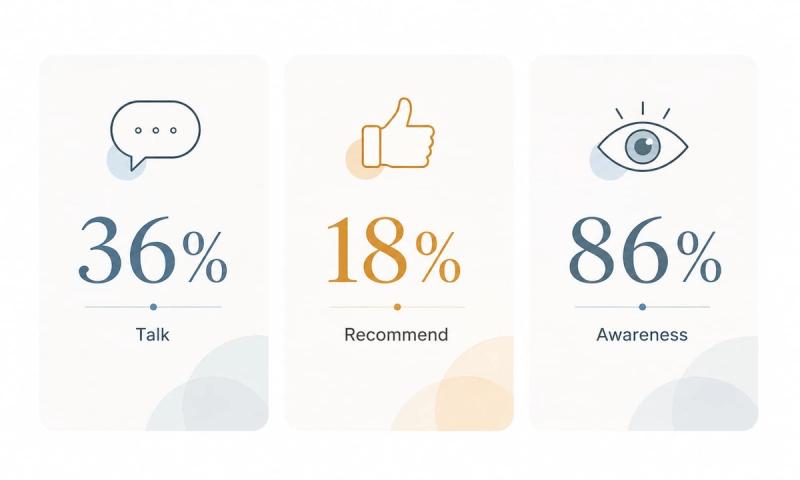
The other network's own October 2025 press release is more direct about it than any outside critic has been. Announcing a new self-serve advertising product for pharmaceutical and health brands, the release states what the platform actually delivers to a paying advertiser: a 36% lift in physicians' intent to talk to their peers about a brand, an 18% lift in intent to recommend it, and an 86% lift in unaided awareness. That's not a side effect of the platform. That's the product.
Verification was never built to protect the quality of the exchange. It was built to prove the audience was real — which made that audience more valuable to sell, not more protected once inside. That same network's own site quietly acknowledges the gap between the pitch and the experience: it names actual Reddit threads where physicians ask whether the platform is even worth using, and chalks the frustration up to how survey eligibility works. That's the company's own explanation for why the people it verified are the ones asking if it's real.
Where Doctors Actually Went Instead
A peer-reviewed study of 581 physicians in a WhatsApp continuing-education group found that 77% joined primarily to discuss difficult cases, 70% specifically valued the insight-sharing from colleagues, and every single respondent rated the group their most beneficial resource for staying current — ahead of medical websites, referral books, and Google.
WhatsApp was never built for medicine. It has no verification layer, no credential check, none of the infrastructure those verified networks spent years building. It's just where doctors decided the actual exchange was worth having, because nobody on the other end of it is measuring lift in brand recall.
This isn't an argument that formal tools always fail. One hospitalist described an internal e-consult tool his hospital built — voluntary, documented in the chart, quick — that he used regularly and found genuinely useful. The difference isn't formal versus informal. It's whether the tool is competing for a physician's attention as its own destination, or sitting quietly inside the workflow they're already in. The verified networks are destinations. A group chat is not.
The Hidden Curriculum Doesn't Need Permission
None of this is really about which app wins. The unwritten etiquette around curbside consults, the instinct for which questions are safe to answer off the cuff, the small social cues a new fellow learns about when to defer — none of it lives in a formal curriculum. It's the hidden curriculum: the actual mechanism by which clinical judgment gets built and passed along, running quietly underneath the official one, because so much of what it teaches can't be assigned as reading.
Verified platforms tried to formalize that mechanism and, in the process, turned it into inventory. Doctors didn't reject verification. They rejected being the product. Whatever channel isn't extracting value from the exchange is the one that survives — that's the actual pattern here, not a preference for one app over another.
Curolynk's own product, Medcoterie, starts from that same read: the case-based exposure that builds real clinical judgment shouldn't depend on which WhatsApp group you happened to get added to, and it shouldn't have to be monetized to exist. Structuring that access, without turning the room into something to sell, is a different problem than the one those verified networks solved — and it's the one that was actually left open.
Frequently Asked Questions
What is a curbside consult?
A curbside consult is when one physician asks another for informal advice on a case — without a formal visit, chart review, or documentation — to get quick input on how to manage a patient. It's distinct from a formal, billed consultation, and it's one of the oldest, most common informal practices in medicine.
Why don't more doctors use verified physician networks for case discussions?
Verification solved the "who am I actually talking to" problem, not the "what happens to this conversation" problem. The largest of these networks generate significant revenue from pharmaceutical and health-brand advertising directed at their own verified physician members — one draws roughly 80% of its revenue this way. That structural fact is a real reason many physicians default to less formal channels instead.
How much of a verified physician network's revenue can come from advertising?
Reuters and CNBC reported in 2021 that approximately 80% of one major verified physician network's revenue came from pharmaceutical and hospital advertising served to the physicians using the platform.
Are curbside consults legally risky?
They carry some risk, mainly when a consulting physician's advice becomes specific enough to imply a doctor-patient relationship, or when their name ends up documented in a chart for a patient they never formally evaluated. Physicians are generally advised to keep curbside advice general and non-patient-specific, and to move to a formal consult once a case is complex enough to need one. This isn't legal advice — consult your institution's risk management guidance for anything specific.
Why do doctors use WhatsApp for medical case discussions?
A peer-reviewed study of 581 physicians in a WhatsApp continuing-education group found 77% joined specifically to discuss difficult cases, and every respondent rated the group as their most valuable resource for staying current — ahead of medical websites, referral books, or Google. WhatsApp wasn't built for medicine, but unlike the verified physician networks, it isn't competing for physicians' attention as its own destination, and nobody's monetizing the exchange.
References
- MedCentral, citing JAMA-sourced curbside consult prevalence data: https://www.medcentral.com/biz-policy/physician-curbside-consult-evolution-and-risks
- Financial analysis citing a verified physician network's fiscal 2021 disclosure that advertising made up over 80% of its revenue: https://vator.tv/2021-07-08-how-does-doximity-make-money/
- CNBC, August 2021, on vaccine misinformation found circulating on a verified physician network's platform: https://www.cnbc.com/2021/08/06/doximity-social-network-for-doctors-full-of-antivax-disinformation.html
- A verified physician network's advertiser-engagement product announcement, October 2025: https://www.businesswire.com/news/home/20251030502623/en
- WhatsApp CME physician study (PMC): https://pmc.ncbi.nlm.nih.gov/articles/PMC11373431/


