
Responsible AI in Healthcare: Principles, Risks, and Guardrails

Artificial intelligence is already embedded in healthcare workflows, quietly shaping how clinicians learn, how cases are discussed, and how medical knowledge is accessed. In many settings, this adoption has happened faster than the systems meant to govern it. The result is a growing gap between what AI can do and what it should be trusted to do in environments where errors carry real human consequences.
This is where the idea of responsible AI in healthcare becomes essential. Not as an abstract ethical ideal, but as a practical framework for designing, deploying, and using AI systems with clear boundaries. In healthcare and especially in medical education, AI does not operate in isolation. It influences clinical reasoning, learning habits, and decision-making patterns long before it ever touches a patient.
Against this backdrop, responsible AI asks a simple but difficult question: How do we benefit from AI without letting it quietly erode judgment, accountability, or trust? Answering that requires more than technical performance. It requires intent, restraint, and governance built into the system from the start.
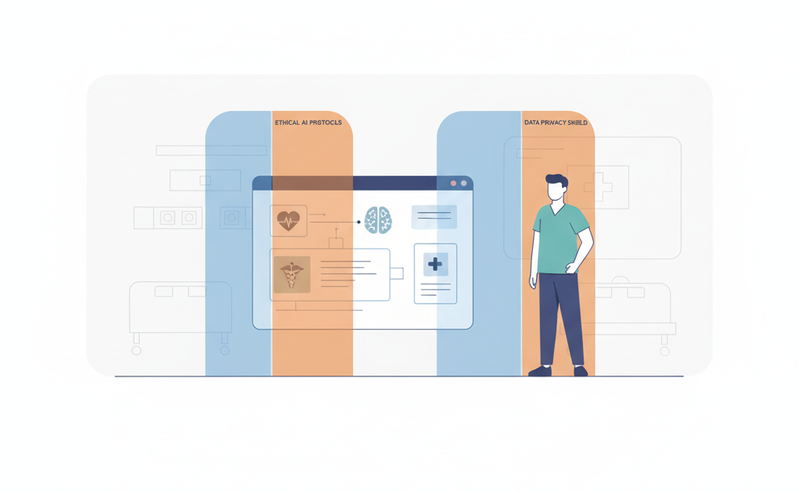
Why “Responsible AI” Matters More in Healthcare Than Anywhere Else
AI is used across many industries, but healthcare is fundamentally different. Here, decisions influence diagnoses, treatments, and long-term patient outcomes. Even when AI is applied only to education or decision support, its effects ripple outward — shaping how clinicians think, what they trust, and how they act under pressure.
Three reasons responsibility carries more weight in healthcare than in most other domains:
- Errors are not abstract. A flawed recommendation in a consumer app might inconvenience a user; a flawed explanation in a medical learning context can misinform a future clinician. When AI systems present information confidently even when incorrect, the risk is not just technical failure but misplaced trust.
- Authority and fluency are easily confused. Modern AI systems generate responses that sound coherent and persuasive. For medical students or early-career professionals, this fluency can blur the line between verified knowledge and probabilistic output. Without safeguards, AI can unintentionally reinforce misconceptions rather than correct them.
- Accountability is complex but unavoidable. In healthcare, responsibility cannot be delegated to a system. Someone — an educator, an institution, a clinician — remains accountable for decisions influenced by AI. Responsible AI in healthcare therefore demands clarity: Who oversees the system? Where does its authority end? And how are its limitations communicated to users?
For these reasons, responsibility in healthcare AI is not about slowing innovation. It is about ensuring that innovation strengthens clinical reasoning rather than shortcutting it.What Responsible AI Actually Means (Beyond Ethics Buzzwords)
What Responsible AI Actually Means (Beyond Ethics Buzzwords)

In healthcare, the phrase responsible AI is often reduced to ethics checklists — fairness, bias mitigation, or compliance reviews. While these are important, they are incomplete. Responsibility in healthcare AI is less about slogans and more about how systems behave in real-world use, especially when users are learning, reasoning, or making decisions under uncertainty.
At its core, responsible AI in healthcare means designing systems that are aware of their role and limits. Three ideas help clarify what this actually involves in practice:
- Epistemic humility. Healthcare AI systems should not behave as if they "know" in the way clinicians do. Their outputs are probabilistic, derived from patterns in data, not understanding.
- Bounded use by design. Responsible AI does not attempt to solve every problem. It operates within clearly defined scopes — what it can assist with, what it should not attempt, and when it should defer to human judgment. In medical education, this is especially critical, as learners are still forming mental models and clinical reasoning habits.
- Accountability embedded into the system, not added later. Responsibility is not achieved by placing disclaimers on top of powerful tools. It is achieved when oversight, review mechanisms, and escalation paths are built into how the system functions.
Seen this way, responsible AI is not an obstacle to innovation. It is a design philosophy that treats safety, clarity, and trust as core features — particularly in healthcare contexts where the cost of misplaced confidence can be high.Core Principles of Responsible AI in Healthcare
Core Principles of Responsible AI in Healthcare
Responsible AI in healthcare becomes meaningful only when its principles are translated into concrete design choices. These principles function as guardrails that shape how AI systems interact with clinicians, students, and healthcare institutions.
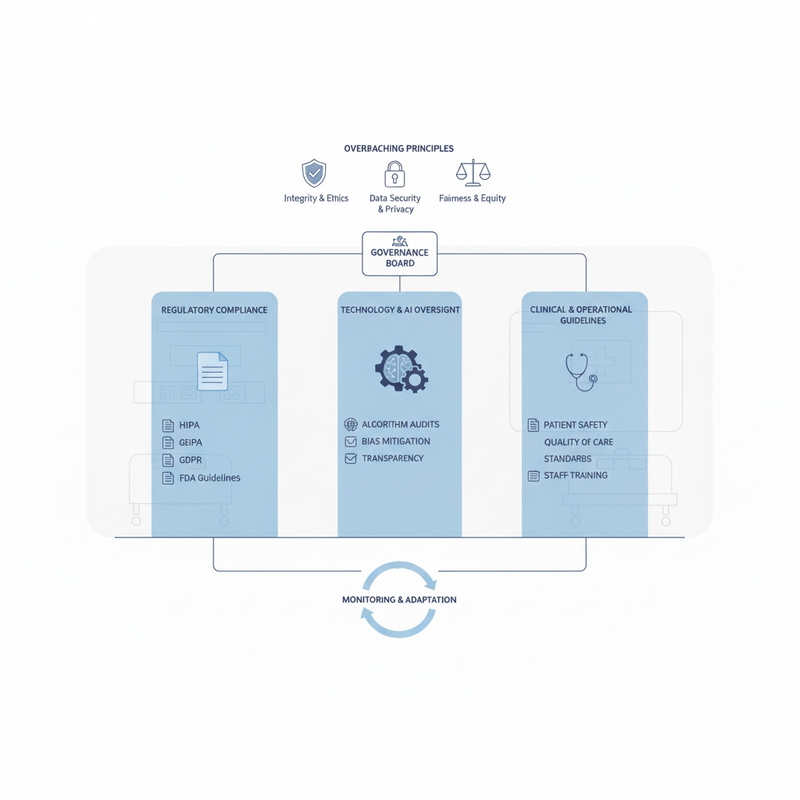
Transparency and Explainability
In healthcare, users must understand when AI is involved and how its outputs are generated at a high level.
Responsible systems:
- Clearly signal AI involvement
- Avoid presenting outputs as unquestionable facts
- Provide context around how answers are formed
For learners especially, transparency helps distinguish assistance from authority — a critical distinction in medical education.Human Oversight and Accountability
Human Oversight and Accountability
AI in healthcare should always function under human supervision. Responsibility cannot be automated away.
This principle requires that:
- Humans retain final decision-making authority
- AI outputs are treated as inputs, not conclusions
- Accountability is clearly assigned to individuals or institutions
Responsible AI makes accountability explicit rather than implicit.Safety, Validation, and Scope Control
Safety, Validation, and Scope Control
Healthcare AI systems must be validated for specific use cases, not assumed to be broadly reliable.
Responsible design includes:
- Clearly defined boundaries of use
- Explicit acknowledgment of where the system should not be relied upon
- Ongoing evaluation as contexts, guidelines, and data evolve
In medical education, scope control is especially important. Overgeneralized assistance can distort learning rather than support it.
Continuous Monitoring and Feedback
Responsibility does not end at deployment. Healthcare environments are dynamic — clinical guidelines change, educational standards evolve, and real-world usage often diverges from intended use.
Responsible AI systems incorporate:
- Monitoring for drift and misuse
- Feedback loops from users
- Processes for updating or restricting functionality when risks emerge
This ongoing attention is what separates responsible systems from static tools that gradually become unsafe over time.
These aren't hypothetical. Geisinger Commonwealth School of Medicine's generative-AI policy explicitly ties student use back to its parent health system's AI Governance Policy — a Medical Curriculum Committee handles standard educational use, while higher-risk uses escalate to an AI Executive Steering Committee. That's accountability embedded into the system, not layered on after, made concrete rather than aspirational.
Taken together, these principles reinforce a central idea: responsible AI in healthcare is not a single feature or policy. It is an ongoing commitment to designing systems that respect uncertainty, preserve human judgment, and prioritize trust over convenience.
Where Medical Education's AI Governance Actually Stands

Medical education is often treated as a low-risk place to experiment with AI — students are learning, not yet treating patients directly. But the governance meant to keep that experimentation responsible is inconsistent at best.
A 2026 study in The Clinical Teacher examined AI guidance across US medical schools and found that most rely on generic academic-integrity or large-language-model policies written for the student body at large, rather than guidance built specifically for how medical students use AI in coursework and clinical training. Where medical-student-specific policies do exist, they vary widely in scope and enforcement — the study's authors describe this as a genuine policy gap, not a minor inconsistency, one that leaves learners without clear expectations for how they're actually supposed to use these tools.
A few schools have built out real policy in response:
- Geisinger Commonwealth School of Medicine's policy applies across coursework, clerkships, and electives, and explicitly requires alignment with its parent health system's AI Governance Policy — standard educational use runs through a Medical Curriculum Committee, while higher-risk use (patient care, research) escalates to an AI Executive Steering Committee.
- University at Buffalo's Jacobs School of Medicine built its policy around a single stated concern: that unsupervised AI reliance can erode independent clinical reasoning and professional accountability before students ever reach a patient.
- University of Arizona College of Medicine's student AI policy leads with a plain rule — AI should supplement learning, not replace the reasoning it's meant to build — and requires students to disclose AI use and take responsibility for the resulting work.
These policies differ in detail, but they converge on the same idea this piece has been building toward: responsibility that's designed in from the start, not bolted on once something goes wrong. The gap the Clinical Teacher study identifies isn't that responsible-AI principles are unclear. It's that most institutions haven't yet translated those principles into something a medical student can actually be held to.Why Responsibility Starts With Acknowledging AI’s Limits
Why Responsibility Starts With Acknowledging AI's Limits
None of this works without acknowledging what AI genuinely cannot do. AI systems used in medical education don't possess clinical understanding — they generate responses based on patterns in data, not judgment or lived experience, and can produce confident, fluent answers that are still wrong. The specific ways this shows up for medical students are covered in more depth in Limitations of AI in Medical Education; the point here is that no governance policy or set of principles works without first being honest about that limit.
What Responsible AI Looks Like in Practice
In practice, responsible AI in healthcare is less about ambitious capabilities and more about deliberate restraint. Systems designed with responsibility in mind tend to share a few characteristics, regardless of the specific technology involved:
- They make the role of AI explicit. Users are never left guessing whether a response is generated by a human expert or an automated system — a distinction that matters in medical education, where understanding howinformation is produced is as important as the information itself.
- They prioritize support over substitution. Rather than positioning AI as an answer engine, they frame it as a tool that assists exploration, prompts further inquiry, or helps organize thinking — preserving clinical reasoning instead of bypassing it.
- They surface uncertainty and encourage verification. Outputs are not presented as final truths. Users are nudged to cross-check, consult peers, or refer back to established sources and guidelines — reinforcing skepticism, validation, and accountability.
- They build in system boundaries. Certain questions are deliberately constrained. Some responses are withheld or redirected rather than answered outright.
This is also where the governance gap identified above actually gets closed — not through a written policy alone, but through a system that makes the policy's intent structurally difficult to ignore. Curolynk's own approach treats this as a design constraint from the start: accountability and peer oversight built into how students engage with AI-assisted discussion, rather than a disclaimer layered on top of it.
What matters here is not the specific implementation, but the underlying philosophy. Responsible AI in healthcare is visible not in what a system claims it can do, but in where it chooses to stop.
Responsibility Is a Design Choice, Not a Compliance Step
Responsible AI in healthcare is not achieved through policy statements or post-hoc disclaimers. It emerges from the everyday decisions made while designing, deploying, and using AI systems — decisions about boundaries, oversight, and how much authority a system is allowed to carry.
In medical education, these choices matter even more, and right now, most institutions haven't made them yet. AI tools influence how clinicians learn to think, question, and reason long before they face real patients. When responsibility is treated as optional, secondary, or simply undecided, the risks are subtle but lasting: overconfidence, weakened judgment, and misplaced trust.
Systems and institutions that are clear about what they can and cannot do create space for human expertise to remain central, where it belongs in healthcare. Transparency, accountability, and restraint are not barriers to progress — they are prerequisites for trust.
Ultimately, responsible AI in healthcare is less about building more capable systems and more about building wiser ones— systems that know their role, respect uncertainty, and support human judgment rather than competing with it. That is where responsibility moves from theory into practice, and where trust is earned, not assumed.References
References
- World Health Organization (WHO). Ethics and Governance of Artificial Intelligence for Health. WHO, 2021. https://www.who.int/publications/i/item/9789240029200
- National Academy of Medicine. Artificial Intelligence in Health Care: The Hope, the Hype, the Promise, the Peril.National Academy of Medicine, 2019. https://nam.edu/artificial-intelligence-in-health-care/
- Organisation for Economic Co-operation and Development (OECD). OECD Principles on Artificial Intelligence. OECD, 2019. https://oecd.ai/en/ai-principles
- U.S. Food and Drug Administration (FDA). Artificial Intelligence and Machine Learning in Software as a Medical Device. FDA Discussion Paper, 2021. https://www.fda.gov/medical-devices/software-medical-device-samd/artificial-intelligence-and-machine-learning-software-medical-device
- Topol, Eric. Deep Medicine: How Artificial Intelligence Can Make Healthcare Human Again. Basic Books, 2019.
- Nature Medicine Editorial. Implementing Trustworthy Artificial Intelligence in Health Care. Nature Medicine, 2020. https://www.nature.com/articles/s41591-020-01118-4
- European Commission – High-Level Expert Group on Artificial Intelligence. Ethics Guidelines for Trustworthy AI.European Commission, 2019. https://digital-strategy.ec.europa.eu/en/library/ethics-guidelines-trustworthy-ai
- Bridging the AI Policy Gap in Medical Education: Assessing the Lack of Standardised Guidelines in US Medical Schools.The Clinical Teacher, 2026;23(2):e70347. https://doi.org/10.1111/tct.70347
- Geisinger Commonwealth School of Medicine. AI use recommendations and action steps for the MD program (via AAMC). https://www.aamc.org/media/86766/download?attachment=
- University at Buffalo, Jacobs School of Medicine and Biomedical Sciences. Generative Artificial Intelligence Use Policy for Medical Students in the Medical Curriculum. https://medicine.buffalo.edu/offices/ome/current/policies/ai-policy.html
- University of Arizona College of Medicine – Tucson. Policy on Student Use of AI. 2024. https://www.medicine.arizona.edu/sites/default/files/2024-11/Policy-on-Student-Use-of-AI-2024-11-13.pdf


