
Limitations of AI in Medical Education: Risks for Medical Students

Artificial intelligence (AI) tools are increasingly being used by medical students and early residents for studying, revision, and quick clarification of concepts. From summarizing textbooks to answering clinical questions, AI promises speed and convenience in a field known for its overwhelming volume of information.
However, medical education is not simply about accessing information. It is about developing clinical reasoning, judgment, ethical responsibility, and contextual understanding. These skills form gradually and require deliberate effort. When AI tools are used without awareness of their limitations, they can interfere with this learning process.
As the use of AI in medical education grows, understanding the limitations of AI for medical students and early residents becomes essential for safe and effective learning.

How AI Is Currently Used in Medical Education
Today, AI tools are commonly used by medical learners to:
- Summarize medical topics
- Explain complex concepts in simpler language
- Generate practice questions
- Answer theoretical or clinical queries
- Assist with exam revision
These uses can be helpful, especially for organization and clarification. However, problems arise when AI-generated outputs are accepted without verification or used as a replacement for primary learning.
AI Does Not Possess Clinical Reasoning Like Human Clinicians
Modern AI systems work by recognizing patterns in large datasets. They do not reason in the human sense.
Clinical reasoning involves:
- Interpreting incomplete or conflicting information
- Weighing probabilities rather than certainties
- Integrating patient context, experience, and judgment
While AI may produce an answer that appears clinically sound, it does not understand why that answer is appropriate. For medical students and early residents, who are still learning how to think clinically, this distinction is critical.
Relying on AI-generated conclusions too early can weaken the development of independent reasoning skills that are essential for real-world practice.
Limited Transparency and Verifiability of Sources
Many AI tools do not consistently cite exact textbook references, guideline versions, or the strength of evidence behind an answer. In medicine, where guidelines evolve and standards of care differ by region and institution, an answer without clear sourcing can't be reliably validated — a gap explored in more depth in Responsible AI in Healthcare, where transparency is treated as a core design principle rather than a footnote.
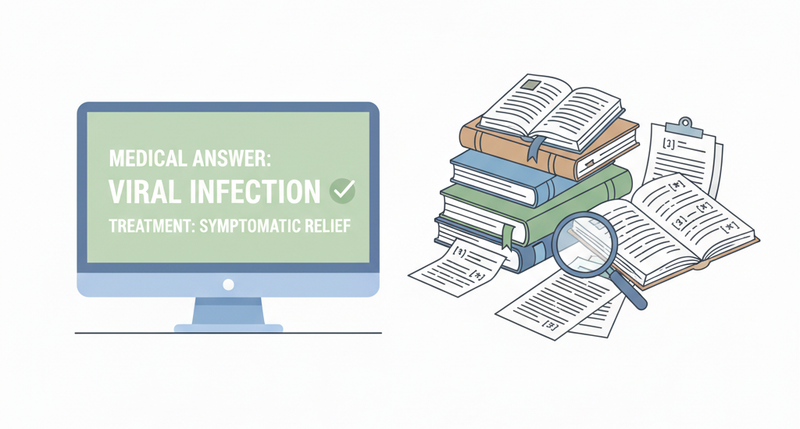
Risk of Confident but Incorrect Information (Hallucinations)
AI systems can generate information that sounds fluent, uses correct terminology, and is still factually wrong — errors often called hallucinations. Early learners may lack the experience to catch these inaccuracies before they're memorized and reproduced, which is exactly why human oversight remains essential in AI-assisted healthcare systems. In healthcare, confident misinformation is more dangerous than uncertainty.
How AI Can Reinforce Surface-Level Learning in Medical Students
AI tools make it easy to obtain answers instantly. While this can save time, it may also encourage skipping detailed reading, avoiding cognitive struggle, and memorizing conclusions without understanding mechanisms. Medical education relies on deep learning — pathophysiology, pharmacology, cause-effect relationships — and when AI replaces effortful thinking instead of supporting it, learning becomes superficial.
Absence of Real Clinical Experience
Clinical practice is shaped by resource availability, institutional workflows, patient preferences, and system-level constraints — the kind of context AI systems, trained on aggregated data rather than lived experience, cannot convey.
This same data-dependence shows up as bias: AI models inherit whatever gaps exist in their training data, including underrepresentation of certain populations and outdated practice patterns, and can reinforce those gaps in a learner's understanding if left unrecognized. For learners, both limit AI's ability to prepare them for the trade-offs and constraints that define real clinical environments.
AI Cannot Replace Peer-to-Peer and Mentor-Based Learning
Some of the most valuable learning in medicine happens through case discussions, ward-based teaching, peer debate, and learning from seniors' experience — interactions that expose uncertainty, encourage questioning, and build professional identity.
This is also where ethical and professional judgment is actually learned: through mentorship, reflection, and clinical exposure, not through automated output. AI can describe an ethical framework, but it operates in isolation and cannot replicate the collective process that teaches a student to carry responsibility for a decision.
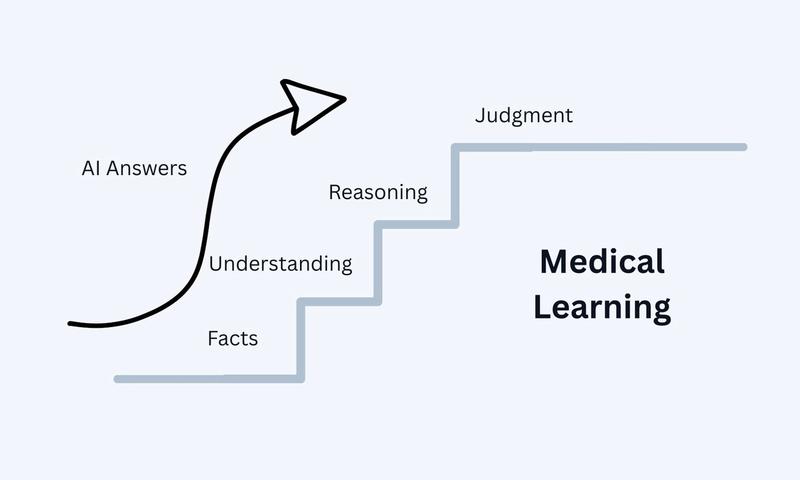
Why AI Often Conflicts with How Medical Students Learn to Think (A Cognitive-Stage Perspective)
Medical students do not become clinicians simply by accumulating information. They progress through distinct stages of cognitive development, each requiring time, effort, and uncertainty.
Psychologist George Miller mapped this progression decades ago, from knows to knows how to shows how to does — and each stage still has to be built, not skipped.
Early medical learning is intentionally slow, and there's a reason for that beyond tradition. Cognitive load theory, first described by educational psychologist John Sweller, holds that working memory is limited, and skills only become durable when a learner processes material actively rather than receiving it pre-solved.
Students must memorize foundational facts, understand mechanisms, and practice structured problem-solving — not because slower is inherently better, but because that effort is the mechanism by which the learning actually sticks.
AI tools, in contrast, provide immediate, polished answers. When students rely on these outputs too early, they may bypass exactly the cognitive work Sweller's research says is required to build reasoning skills.
There's a version of this in Daniel Kahneman's distinction between fast, intuitive thinking and slow, effortful reasoning. Experienced clinicians can rely more on fast pattern recognition precisely because they've already put in years of the slow, effortful kind — Miller's does stage doesn't arrive early.
AI systems are pattern-recognition engines by design. When novice learners are exposed to expert-level pattern outputs before they've done the slow reasoning that pattern recognition is supposed to replace, they risk skipping the stage entirely rather than earning it.
Another risk is what psychologists Leonid Rozenblit and Frank Keil termed the illusion of explanatory depth: people consistently overestimate how well they understand something once they've seen a fluent explanation of it, even when they couldn't reconstruct that explanation themselves.
Because AI explanations are fluent and well-structured, learners may feel they understand a topic when they have only recognized an explanation rather than constructed one — the exact gap Rozenblit and Keil's research describes.
This matters deeply in medicine, where decisions involve uncertainty, responsibility, and real consequences. AI cannot accelerate cognitive development beyond what the learner is ready for.
The key question is not whether AI is good or bad, but when and how it is used within the learning process.
These learning-stage mismatches reflect broader concerns about how AI systems are designed, governed, and supervised across healthcare, not just in education.
Appropriate Role of AI in Medical Education
AI can be useful when positioned correctly. Appropriate uses include:
- Clarifying concepts after primary study
- Organizing information
- Assisting with revision
- Prompting further reading
A more detailed discussion of how medical students can use AI tools responsibly — along with their risks and benefits is explored separately.
AI becomes problematic when it replaces first-pass learning or discourages effortful thinking.AI becomes problematic when it replaces first-pass learning or discourages effortful thinking.

Conclusion
AI has real value in medical education, but its biggest risk isn't any single wrong answer — it's the temptation to let a fast, fluent tool substitute for the slow, effortful stages that clinical reasoning is actually built from. Medicine requires judgment, accountability, and contextual understanding that develop over time, not on demand.
For medical students and early residents, recognizing this is essential. AI should assist learning, not replace the cognitive and ethical processes — the stages Miller, Sweller, and others have spent decades describing — that define how a clinician is actually made.
Understanding where AI falls short is not a rejection of technology; it is a prerequisite for using it responsibly.
References
- Kahneman D. Thinking, Fast and Slow. Farrar, Straus and Giroux; 2011.
- Norman G, Eva K. Diagnostic error and clinical reasoning. Academic Medicine. 2010;85(2):S1–S6.
- Sweller J. Cognitive load during problem solving: Effects on learning. Cognitive Science. 1988;12(2):257–285.
- Bloom BS, et al. Taxonomy of Educational Objectives. 1956.
- Rozenblit L, Keil F. The misunderstood limits of folk science. Cognitive Science. 2002;26(5):521–562.
- Miller GE. The assessment of clinical skills/competence/performance. Academic Medicine. 1990;65(9):S63–S67.
- Parasuraman R, Molloy R, Singh I. Performance consequences of automation-induced complacency. International Journal of Aviation Psychology. 1993.


